You have decent people. You have a process of some kind. And still, every project has a moment where someone needs to chase something, figure something out on the spot, or come back to you because they're not sure what to do next.
It doesn't feel like a team problem. It doesn't feel like a skills problem. It just feels like delivery never quite runs on its own.
Most founders I work with have been trying to fix this for a while. A new project manager. A better briefing template. A weekly team call to stay on top of things. Sometimes it helps a bit. Usually the same issues come back.
Here's what's usually going on.
The real issue is nobody designed how delivery works
When agencies grow, delivery grows with them. You take on a project, you figure out how to get it done, it works, you do it again. Over time you have something that looks like a process because the same steps happen in roughly the same order. But nobody sat down and designed it.
What that means in practice: your team knows what to do at each stage, but not always why, or what standard they're aiming for, or what happens when something is off. So they come to you. Or they guess. Or they do it differently each time.
That's not a people problem. That's an operating model problem.
What an operating model is and why it matters
An operating model is the logic behind how your agency delivers. Not a list of tasks, but the answers to questions your team needs to do good work without you: Who decides what? What does quality look like at each stage? Who talks to the client when something changes? What gets escalated and what doesn't?
Most agencies don't have this written down or agreed on. They have the founder's version of it, which lives in the founder's head and gets applied case by case. Which is fine when you're doing most of the work yourself. It stops working when you need a team to carry delivery without you making the calls.
Why hiring and SOPs don't fix it on their own
A senior hire can take work off your plate, but they can only work with what exists. If the decisions are still yours, they'll come to you for them. If the quality standard isn't defined, they'll apply their own, which may or may not be yours.
SOPs have the same problem. A SOP tells someone what steps to follow. It doesn't tell them how to think about the work, or what to do when reality doesn't match the template. The moment something unusual happens, which is most of the time in agency work, someone still has to make a judgment call. Usually that's you.
Neither of those things gives your team the operating logic they need to run delivery without pulling you in.
What changes when you design it properly
When the operating model is designed, your team can answer most questions themselves. Not because they're more experienced, but because the logic is there. They know what quality looks like. They know who owns what. They know what to do when something goes sideways.
It also changes how AI fits into delivery. Right now, most agencies are using AI in the places that feel easy. The real opportunity is understanding which parts of your delivery can be carried by AI, which parts need a person, and where the quality risk is if you get that wrong.
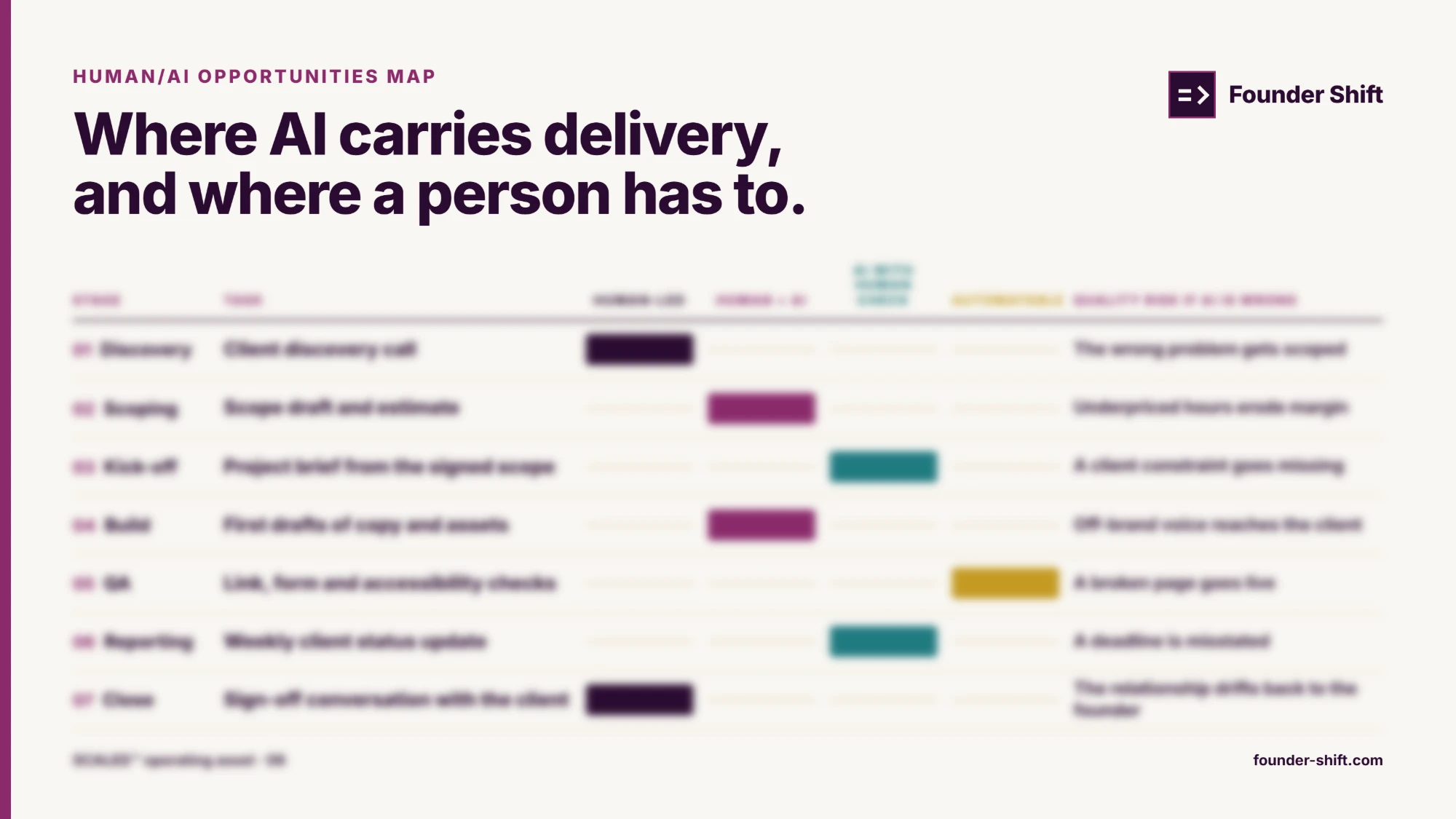
That kind of clarity doesn't come from experimenting with tools. It comes from mapping your delivery and knowing what each stage actually requires.
Where to start if this sounds familiar
The first thing is to stop looking for the thing to add and start looking at the system. Not the tasks, the logic underneath them. Who actually owns delivery decisions right now? What happens when a project goes off track? Where does everything still run through you?
Those answers tell you what's missing. Usually it's not more people or better software. It's the operating model that was never designed.
That's the work CONFIGURE™ is built around. Mapping how delivery actually works in your agency, designing the model that makes it run without you, and figuring out where AI fits in a way that holds quality.